The prevention of frailty in seniors relies on specific levers, often underutilized in standard care pathways. We observe that the most effective approaches combine targeted medical prescriptions, technical home adaptations, and maintaining a sufficient health literacy to avoid poorly informed decisions.
Early detection of frailty: markers to monitor before the loss of autonomy
Frailty is not a binary diagnosis. French health authorities emphasize three warning signals that precede the loss of autonomy by several months: involuntary weight loss, persistent fatigue, and decreased walking speed.
These markers, taken in isolation, often go unnoticed during standard consultations. Their combination constitutes a strong signal. We recommend structured screening starting at age 65, incorporating an objective measurement of walking speed over four meters.
The recommended pathway then combines adapted physical activity, home modifications, and nutritional correction. This triptych, when coordinated by the primary care physician, significantly delays the transition to dependence. Several specialized resources help guide families, notably the neo-sante.fr website dedicated to seniors, which gathers information on these pathways.
Physical activity on prescription: a device still underused by seniors
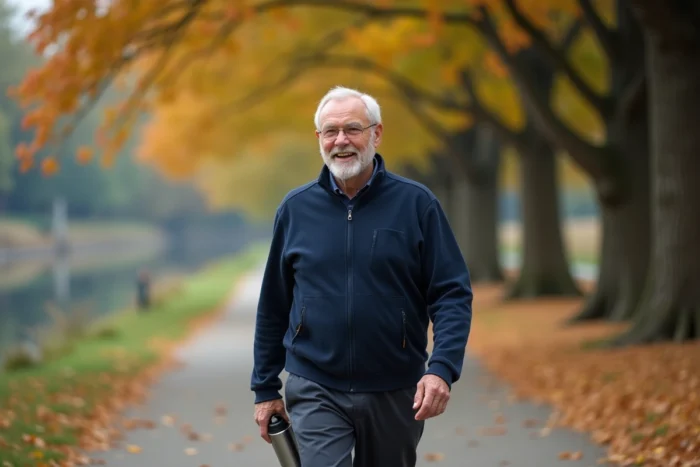
Since 2022, several French municipalities (Strasbourg, Montpellier, Lyon, Grenoble) have structured systems for medical prescription of adapted physical activity specifically aimed at those over 60. Partial coverage by municipalities or ARS concretely changes access to adapted sports for fragile profiles.
The principle is simple: the primary care physician prescribes physical activity as they would prescribe medication. The patient is directed to a trained sports educator in a certified facility.
What prescription sports concretely changes
The main barrier to maintaining physical activity after age 65 is neither motivation nor availability. It is the lack of medical framing that reassures the patient and their family. The prescription removes this barrier.
- Sarcopenia (age-related muscle loss) slows down with supervised strength training sessions two to three times a week
- The risk of falls decreases when balance and proprioception are worked on in a supervised setting, not independently at home
- The anxiolytic and antidepressant effects of daily walking are documented, but the benefit is maximal when the activity is regular and progressive
Yoga, swimming, and aquagym remain relevant options. Their appeal lies in the low joint strain, a decisive criterion for seniors suffering from arthritis or back conditions.
Home modifications and fall prevention: neglected technical areas
Adapting the home is not limited to installing a grab bar in the shower. We find that the most effective modifications concern nighttime lighting, the removal of door thresholds, and flooring.
A slippery floor in a poorly lit corridor causes more hip fractures than the absence of a handrail in the stairs. The priorities for modifications should follow a logical pathway: bedroom, corridor, bathroom, kitchen.
Financial aids for home adaptation
Several aid programs exist in France to finance these works. Staying at home remains less expensive than placement in an institution, and municipalities have integrated it into their aging policies. The request usually goes through the APA (personalized autonomy allowance) or through Anah aids for homeowners.
An ergonomic evaluation of the home before any modifications helps avoid poorly targeted investments. An occupational therapist identifies areas of real risk, not those assumed to be dangerous.
Health literacy of seniors: knowing how to sort medical information
Recent programs target a blind spot in prevention: the ability of older adults to assess the reliability of a source of medical information. Knowing how to distinguish an institutional site from an unmoderated forum, questioning a treatment with their doctor, asking for a second opinion—this is all learnable.
Health literacy workshops are developing in several associative and hospital structures. Their goal is not to turn seniors into medical experts, but to equip them with the tools to actively participate in their health decisions.
Why misinformation affects seniors more
The use of social media as a source of health information is increasing among those over 60, without critical sorting skills keeping pace. Misinformation about treatments, dietary supplements, or miracle diets circulates widely.
- Favor institutional sites (HAS, Ameli, Ministry of Health) over unverified Facebook groups or YouTube channels
- Prepare each medical consultation with a written list of questions to optimize the exchange time
- Seek a second medical opinion without guilt, especially for significant decisions (surgery, long-term treatment)
Sleep, varied nutrition, and social connections remain pillars of seniors’ well-being. However, their effectiveness depends on the quality of the information on which daily choices are based. A well-informed senior ages better than a well-supported but poorly advised senior.