
You pull out clumps of oxalis every spring, and each summer they come back more numerous. This frustrating scenario is due to the very biology of the plant: depending on the species, oxalis spreads by seeds, by underground bulbils, or both at the same time. Choosing a chemical treatment suitable for the propagation method of your oxalis radically changes the outcome. Without this distinction, you risk treating blindly, with poorly targeted products and a garden that remains overrun.
Seed oxalis or bulb oxalis: the diagnosis that determines the entire treatment
Before buying any product, look at what is happening underground. Carefully dig up an oxalis plant. If you find tiny white or pink bulbils attached to the roots, you are dealing with a bulbous perennial species. If the plant comes off easily without leaving visible bulbils, it is probably an annual form that spreads by seeds.
This simple observation has direct consequences on the choice of herbicide. A pre-emergent herbicide only works on seed oxalis, as it prevents germination. On a bulbous perennial species, it will be completely ineffective: the bulbils will regrow from the soil without going through the seed stage.
To learn more about chemical treatment for oxalis, you must first make this diagnosis. It is the foundation of any coherent strategy.

Pre-emergent herbicide against annual oxalis: active ingredients and application window
Pre-emergent herbicides work by forming a chemical barrier in the first few centimeters of soil. They neutralize seeds at the time of germination, before the seedling breaks the surface.
Two active ingredients stand out for this use:
- Isoxaben: a selective molecule that targets dicotyledons (including oxalis) without harming grass in lawns. It is applied before the emergence of weeds.
- Dithiopyr: another effective pre-emergent against oxalis, which also acts on certain undesirable grasses. Its spectrum is slightly broader.
The application window is critical. These products must be spread before the soil temperature reaches about 10 to 13 °C in spring. Beyond this threshold, the seeds have already begun to germinate, and the pre-emergent loses its usefulness.
Have you noticed that oxalis appears very early in the season? This is precisely why a late treatment misses its target. It is better to intervene as early as the end of winter when the soil is still cool.
Systemic post-emergent against bulbous perennial oxalis
If your oxalis forms bulbils, the pre-emergent will be of no use. You need to switch to a systemic post-emergent herbicide, which is a product absorbed by the leaves and transported to the roots and underground organs.
Glyphosate: effective but non-selective
Glyphosate destroys all vegetation it touches. It is suitable for treating oxalis in pathways, between paving stones, or in areas you can temporarily sacrifice. Apply it with a brush or as a localized treatment to avoid destroying neighboring plants.
One application is not enough against bulbils. The plant often regrows a few weeks after the first treatment, from intact underground reserves. Plan for at least two to three successive applications, spaced a few weeks apart, targeting each regrowth as soon as it develops a few leaves.
Triclopyr: the selective choice for lawns
Do you want to eliminate oxalis in your lawn without killing the grass? Triclopyr is an active ingredient that targets dicotyledons while sparing grasses. It is a selective post-emergent suitable for ornamental lawns.
This type of product is applied by spraying on the leaves of the oxalis, ideally when the plant is in full growth. As with glyphosate, multiple applications are necessary against bulbous forms. The persistence of triclopyr in the soil remains limited, which reduces the impact on subsequent crops.
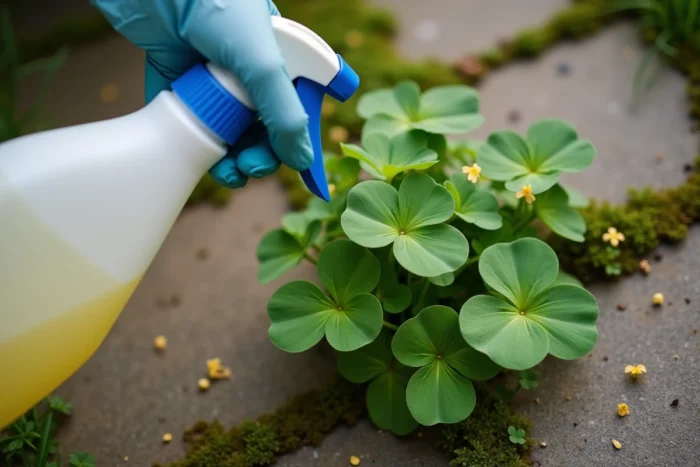
Common mistakes that sabotage oxalis treatment in the garden
Many gardeners apply a total herbicide in spring and consider the problem solved. With oxalis, this approach almost always fails. Here are the most common traps:
- Treating bulbous oxalis only once: dormant bulbils are not reached by the product. Without repeated applications, regrowth is guaranteed.
- Using a pre-emergent on a perennial species: no effect on the already established underground organs. The product is wasted.
- Spraying in windy weather or on dry soil: the product drifts onto cultivated plants or is not properly absorbed by the leaves.
- Tilling the soil after treatment with a tiller: this disperses the bulbils throughout the garden and worsens the infestation instead of resolving it.
The tiller deserves special attention. Each fragmented bulbil can give rise to a new plant. If you need to work the soil, do it before the chemical treatment, not after.
Combining chemical and cultural practices for lasting results
Chemical treatment alone does not solve the problem in the long term. Oxalis thrives in compacted, acidic, or poorly drained soils. If you do not change the conditions that favor it, the plant will return as soon as treatments stop.
After applying a systemic post-emergent on the regrowth, cover the soil with a thick mulch. This cover limits the germination of residual seeds and slows new emergence. A dense mulch complements the chemical treatment by depriving seedlings of light.
Amending the soil to correct its acidity (if necessary) and improve drainage creates a less welcoming environment for oxalis. These adjustments do not replace the herbicide, but they reduce the pressure of reinfestation season after season.
The choice of the right product therefore depends on a simple initial diagnosis: seeds or bulbils. Start from this observation, select the appropriate active ingredient, and above all, do not stop at the first application. Oxalis tests your consistency as much as your strategy.