Newborns cannot yet regulate their body temperature independently. This physiological fact shapes every clothing choice during the first few months and continues to influence their wardrobe well beyond their first year. Choosing baby clothes therefore means balancing thermal protection, freedom of movement and ease of dressing—three priorities that vary from one season to the next.
Infant thermoregulation and its impact on choosing baby clothes
Infants lose heat mainly through their heads and extremities. Their shivering and sweating mechanisms remain immature for several months, making them vulnerable to both cold and overheating. Dressing a baby is therefore not simply a matter of piling on layers of fabric.
The layering principle remains the most reliable approach: several thin layers make it easy to adjust an outfit by removing or adding a garment depending on the ambient temperature. A practical rule often shared by healthcare professionals suggests adding one layer of clothing compared with what an adult would wear in the same conditions.
To check whether a baby is too hot or too cold, the best approach is to touch their neck or chest rather than their hands or feet, which often feel cool even when the rest of the body is at a comfortable temperature. A damp neck indicates overheating, while a cold neck calls for an extra layer. Specialist children’s clothing stores, such as https://www.poupala.fr, offer garments designed to make layering easier.
Baby clothing fabrics: cotton, merino wool and synthetic fibres
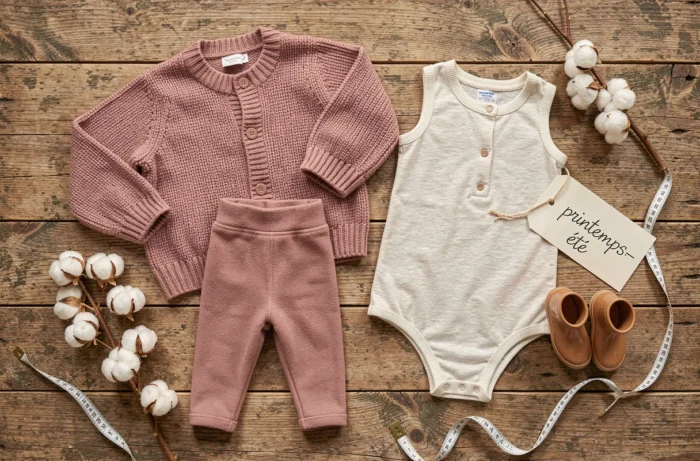
Organic cotton dominates the baby clothing market for a simple reason: its fibres are soft and breathable, and they withstand frequent washing without losing their shape. For bodysuits, pyjamas and everyday outfits, cotton is a reliable choice in every season.
Merino wool deserves special consideration during colder months. Unlike traditional wool, it does not itch against the skin and naturally regulates moisture. A merino bodysuit can be worn as a base layer under a thicker garment without causing irritation, even on atopic skin.
Synthetic fibres (polyester, acrylic) raise more concerns. They dry quickly, which may seem convenient, but they wick away perspiration less effectively and can sometimes trigger skin reactions. Choosing natural fibres for layers that come into contact with the skin helps reduce this risk. Synthetic fabrics are better suited to waterproof outer layers (rain suits, windbreakers), where direct contact with the skin is limited.
Labels and certifications to look for
Checking the fabric composition label before buying helps avoid unpleasant surprises, especially with very low-priced clothing whose manufacturing origins may be difficult to trace.
Practical features: what makes everyday life easier
A baby garment’s comfort is about more than just soft fabric. Ease of dressing and undressing matters just as much, especially for parents changing a nappy several times a day.
- Wrap-front bodysuits (or “kimono-style” bodysuits) avoid having to pull the garment over the head, making them particularly suitable for the first few months, when babies cannot yet support their heads.
- Press studs at the crotch on pyjamas and sleepsuits make nappy changes quick without having to undress the baby completely—a clear advantage when out and about or at night.
- Garments without prominent inner seams reduce friction against the skin, an important detail for babies prone to redness or eczema.
- Envelope necklines (wide and stretchy) make it easier to get the garment over the head without forcing it or upsetting the baby.
A beautiful garment that is difficult to put on ends up at the back of the drawer. Experienced parents will confirm that practicality determines how often a garment actually gets worn.
Size and room to grow
Babies grow in spurts, which can make standard sizes misleading. A “3-month” garment may fit some newborns from birth, while being too small for others of the same age. Buying the next size up every time may seem logical, but clothes that are too big can restrict movement and slip over a baby’s face during sleep.
Choosing a size based on the baby’s actual weight rather than age tends to work better. Most brands now list a weight range as well as an age range on their labels.

Adapting a baby’s wardrobe to the seasons: practical choices
Rather than making an exhaustive season-by-season list, a few key choices can cover the whole year without accumulating dozens of unnecessary items.
In winter, layering a long-sleeved bodysuit, pyjamas and a sleepsuit or thick sleeping bag works just as well in a heated home as outdoors with the addition of a snowsuit. Socks and a hat are not optional extras: the extremities are the main areas through which body heat is lost.
In summer, a short-sleeved cotton bodysuit is often enough indoors. For outings, a wide-brimmed hat and lightweight, covering clothes protect an infant’s skin more effectively than direct sun exposure.
The in-between seasons (spring and autumn) are the most challenging. Temperatures can vary by more than ten degrees between morning and afternoon. This is when layering really comes into its own: a wool or brushed-cotton cardigan that is easy to take off means you do not have to pack two complete outfits in the changing bag.
Versatile pieces to prioritise
A few garments remain useful across seasons: a long-sleeved cotton bodysuit works as a base layer year-round, sleeping bags come in different thicknesses to suit the bedroom temperature, and footed trousers replace the combination of socks and trousers, making dressing easier.
Investing in five to seven bodysuits and three to four pairs of pyjamas per size covers everyday needs, given how often laundry is done. Buying more than this often means accumulating clothes the baby will never have time to wear before outgrowing them.
Ultimately, a baby’s ideal wardrobe consists of just a few well-chosen pieces in suitable fabrics and practical cuts. The rest is more about the parents’ enjoyment than the child’s actual needs.