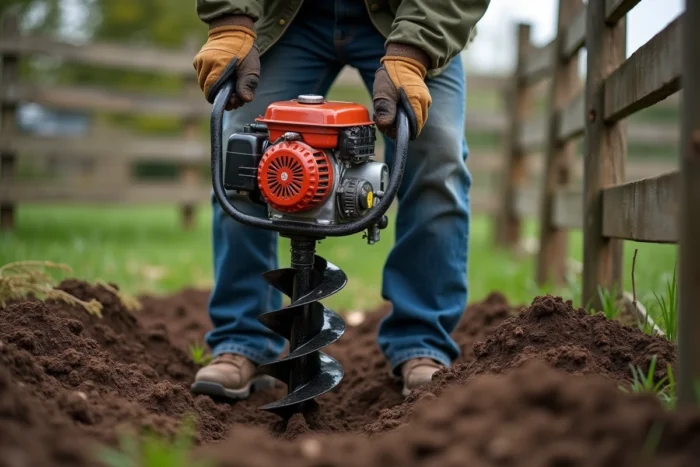
The gas-powered auger saves a considerable amount of time on planting or fence installation work. The gasoline engine drives a rotating bit that drills into the ground instead of your arms. However, between the torque power, vibrations, and the unpredictable nature of the terrain, the operation is not just about pressing the throttle. Several precautions determine both the quality of the hole and the safety of the user.
Buried Networks: The Check That No One Details
Gas-powered auger user guides cover the choice of bit, starting the engine, and digging posture. Almost all of them remain silent on a mandatory prerequisite: check for the presence of buried networks before drilling.
Water pipes, electrical conduits, gas lines, or telecom cables can run through a garden at modest depths. Trenching guides remind us to check the site plan and ensure that no network crosses the area, even for small private works. A bit of an auger spinning at full speed in a live electrical conduit is a serious accident.
Before any intervention, obtain the network plan from your town hall or local manager. Identify the access points, boxes, and ground markings. In case of doubt, offset your holes by at least one meter from a presumed line. This reflex takes a few minutes but conditions the rest of the operation.
For those who want to delve deeper into the actual drilling process, knowing how to use a gas-powered auger also involves mastering the gesture and the right bit equipment.
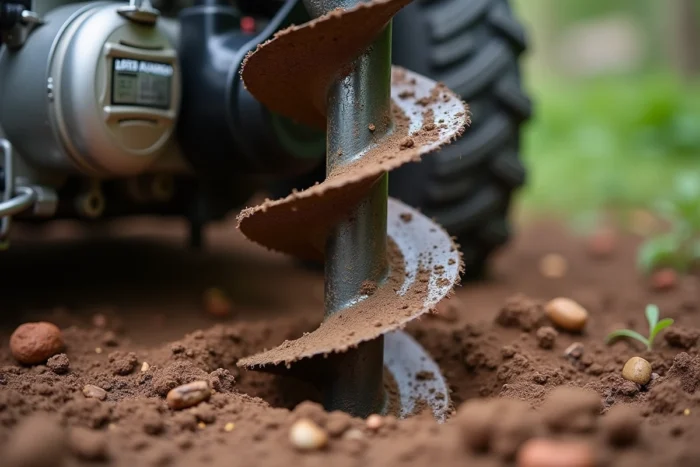
Depth Control of Holes with a Gas-Powered Auger
Digging a hole is easy. Digging a series of holes all at the same depth is another matter. For a fence, a difference of a few centimeters between two posts is immediately noticeable once the stakes are in place.
Direct Marking on the Bit
The simplest method is to wrap a visible piece of tape (like colored duct tape) around the bit at the height corresponding to the desired depth. When the tape is flush with the ground level, you stop descending. This is exactly the principle of the depth stop used in drilling with a pillar drill, scaled down to an auger.
Ground Marker and Template
For serial work (fence posts, light foundations), plant a witness stake next to the first validated hole. Measure the reference depth only once, then transfer it to each new position with a simple tape measure and a paint mark on the bit. Uniform holes avoid having to realign afterward, saving as much time as the auger itself.
Adapting the Bit Diameter to the Type of Soil and Work
The diameter of the bit should not be chosen solely based on the post or plant to be installed. The type of soil plays a decisive role in the machine’s behavior.
- On loose or sandy soil, a large diameter bit works without straining. The engine runs at a moderate speed, and the soil easily rises along the helical spiral.
- On clay or compact soil, reducing the diameter limits the resistance torque. The bit penetrates more easily, and the risk of jamming decreases significantly. Sometimes it’s better to drill a smaller diameter than needed and then manually widen it.
- On rocky soil, no diameter compensates for the presence of stones. Stop the machine as soon as the bit hits a hard obstacle, remove the stone by hand or with a crowbar, and then resume drilling.
A point confirmed by field feedback: forcing on difficult soil in the hope that the engine’s power will suffice is the primary cause of bit breakage and wrist injury. The engine drives the rotation, but it is the nature of the soil that dictates the pace.
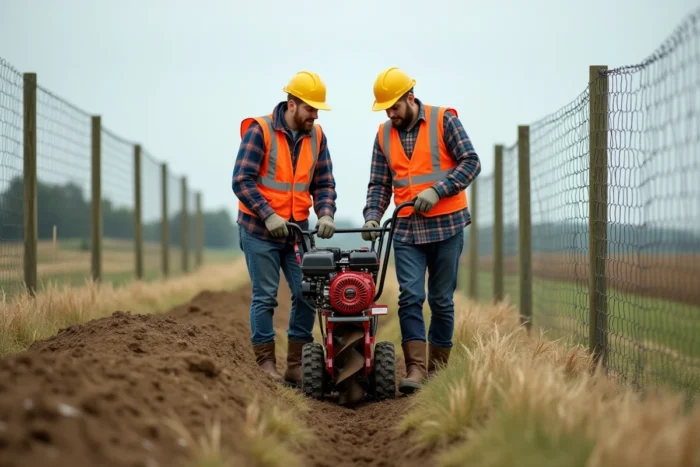
Safety and Posture: What the Engine Torque Imposes on the Body
A gas-powered auger develops a rotational torque that your arms must absorb in the event of a sudden blockage. This is the main point of vigilance, far more than noise or vibrations.
Always hold the machine with both hands, feet shoulder-width apart. Position yourself so that your body is never aligned with the axis of rotation of the bit. If the bit gets stuck in a root or stone, the chassis pivots violently. An unbalanced operator can be thrown off.
- Wear anti-vibration gloves, safety shoes, and protective goggles. Dirt and stone projections are common.
- Check the safety brake before each start. On most models, a lever cuts the rotation of the bit independently of the engine.
- Never work alone on unknown soil. A second person can stabilize the machine during deep drilling or intervene in case of blockage.
The weight of the machine is sufficient to ensure descent in normal soil. Leaning all your weight on the handles only increases the risk of losing control if the bit encounters an obstacle.
Maintenance of the Bit and Engine After Use
Clay soil sticks to the spirals of the bit and hardens as it dries. If you do not clean the bit after each session, the next use starts with a partially obstructed tool, which overloads the engine from the first turns.
A jet of water is enough to remove fresh soil. Then dry the bit to avoid rust, and apply a thin film of oil on the cutting edges. Regarding the engine, empty the fuel tank if the machine remains unused for several weeks. Stagnant gasoline clogs the carburetor and complicates restarting.
Check the condition of the spark plug and air filter according to the frequency indicated by the manufacturer. On a dusty site (dry soil, wind), the filter clogs faster than expected.
The gas-powered auger remains a reliable tool as long as you respect the logic of the terrain before that of the machine. Checking networks, adapting the bit to the soil, controlling the depth, and maintaining everything after each use—these peripheral gestures make the difference between a smooth job site and a day of struggle.