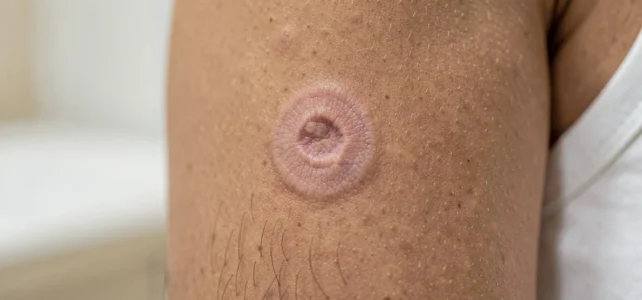
The BCG vaccine, aimed at tuberculosis, is one of the few vaccines that leaves a lasting skin mark after injection. This round scar, often located on the upper left arm, results from a precise biological process related to the very nature of the vaccine and its administration technique.
Intradermal injection and live bacillus: two factors explaining the skin reaction
Most vaccines are injected subcutaneously or intramuscularly. The BCG, however, is administered intradermally, meaning directly into the thickness of the dermis. This superficial layer of skin is rich in immune cells, triggering an intense local response.
The vaccine contains a live attenuated bacillus (Mycobacterium bovis), a weakened form of the bacterium responsible for bovine tuberculosis. Unlike inactivated vaccines, this living microorganism multiplies locally in the dermis for several weeks. The immune system responds by forming a granuloma, a cluster of inflammatory cells that encapsulates the bacteria to neutralize them.
The mark of the BCG vaccine on the arm follows a characteristic sequence: a papule appears in the days following the injection, then evolves into a small nodule. This nodule may ulcerate, ooze for several weeks, then crust over before healing permanently.

Granulomatous inflammation: the mechanism behind the BCG scar
The reaction that leads to the scar has a specific name: granulomatous inflammation. The immune system, upon detecting the live bacilli in the dermis, mobilizes macrophages and lymphocytes. These cells organize into compact structures (the granulomas) to isolate and gradually destroy the bacteria.
This localized battle lasts several weeks. The resulting tissue destruction, combined with surface ulceration, leaves a zone of scar fibrosis. The damaged dermis repairs itself with fibrous tissue, which is more rigid and less flexible than normal skin, producing the characteristic small rounded depression.
This phenomenon is fundamentally different from what occurs with an inactivated vaccine (such as the flu vaccine), where the local inflammatory reaction remains brief and superficial, without significant tissue destruction.
Scar size and vaccination age: a variable mark
Not all individuals vaccinated with BCG bear the same scar. Several factors influence its visibility:
- The age at vaccination plays a direct role. Infants vaccinated in the first months of life generally develop a more visible scar than children or adults vaccinated later.
- The injection technique modifies the intensity of the reaction. An injection that is too deep (subcutaneous instead of intradermal) or a poorly calibrated dose can lead to a more pronounced scar, or even a local abscess.
- The vaccine strain used varies by country and manufacturer. Some strains provoke a more pronounced local reaction than others.
- Individual immune response differs from person to person. A highly reactive immune system will produce a more intense granulomatous inflammation, thus a more visible scar.
In high-income countries where BCG vaccination is practiced later or targeted, scars are often less pronounced than in regions where the vaccine is administered at birth.

Absence of BCG scar: should one revaccinate?
Some vaccinated individuals show no visible mark on their arm. This situation regularly raises the question of potential revaccination. Current recommendations are clear: the absence of a scar does not mean the vaccine did not work.
The BCG protects against severe forms of tuberculosis in children (tuberculous meningitis, miliary tuberculosis) even when no scar forms. The immunity conferred by the vaccine relies on a cellular immune response that does not depend on the presence of a skin mark.
Clinical practice guidelines for healthcare professionals remind us that there is no evidence that revaccinating improves protection in a person already vaccinated without a scar. The visible mark is a side effect of the local reaction, not an indicator of vaccine efficacy.
BCG vaccine and smallpox vaccine: two scars not to be confused
Individuals born before the 1980s may have two vaccination scars on their arm. Confusion between the marks of the BCG and those of the smallpox vaccine remains common.
The smallpox vaccine was administered by scarification: the skin was scratched with a bifurcated needle dipped in the vaccine. This technique produced a wider, often irregular scar with a raised appearance. Smallpox vaccination was discontinued after the disease was eradicated, as declared by the WHO in 1980.
The BCG produces a smaller, smooth, and slightly depressed scar. Both marks are usually located on the same arm (the left in France), which explains the frequent confusion. However, their mechanisms differ: scarification and epidermal destruction for smallpox, deep granulomatous inflammation for BCG.
The BCG scar remains one of the most recognizable vaccination marks in the world. It reflects a unique immunological process, linked to the use of a live bacillus and an uncommon injection route in vaccination. While it has no value as proof of protection, it serves as a visible reminder of a vaccination that continues to prevent the most severe forms of tuberculosis in young children.