Comparing the leisure options available in France involves crossing several variables: the target audience (children, teenagers, adults, seniors), the budget, the location (indoor or outdoor), and seasonality. Rather than creating an endless list of activities, this article measures the gap between a few major categories of leisure to identify those that truly adapt to all ages and desires.
Comparison of Major Leisure Categories by Audience and Budget
The table below groups six common categories of leisure in France. It crosses the age range covered, the relative cost, and the practice setting to highlight the differences.
| Leisure Category | Age Range | Indicative Budget | Indoor / Outdoor |
|---|---|---|---|
| Board Games | From 4-5 years, no limit | Low to moderate | Indoor (or garden) |
| Escape Room | About 8 years and older | Moderate to high | Indoor |
| Nature Outings (hiking, biking) | From walking, no limit | Low | Outdoor |
| Indoor Leisure Spaces | Primarily 2-14 years | Moderate | Indoor |
| Libraries and Media Libraries | All ages | Free or nearly free | Indoor (+ outside) |
| Aquatic Activities (swimming pool, body of water) | From 3 years, no limit | Low to moderate | Outdoor / Indoor |
Two categories cover an almost unlimited age range while remaining financially accessible: nature outings and libraries. Board games compete on budget, but their intergenerational reach depends on the choice of game.
Indoor leisure spaces, which are increasingly appealing to parents according to a report by Ouest-France, actually target a narrow age range. Their cost per session places them in a higher spending category than outdoor activities.

To explore a wide range of activities and games suitable for each profile, the site u-games.ch for leisure groups references categorized by type and age, making comparison easier before making a decision.
Board Games and Creative Hobbies: A Cost-Versatility Ratio Hard to Beat
The board game market continues to grow in France. TF1 Info highlights that board games remain popular and that new references appear each season to liven up family or friends’ evenings.
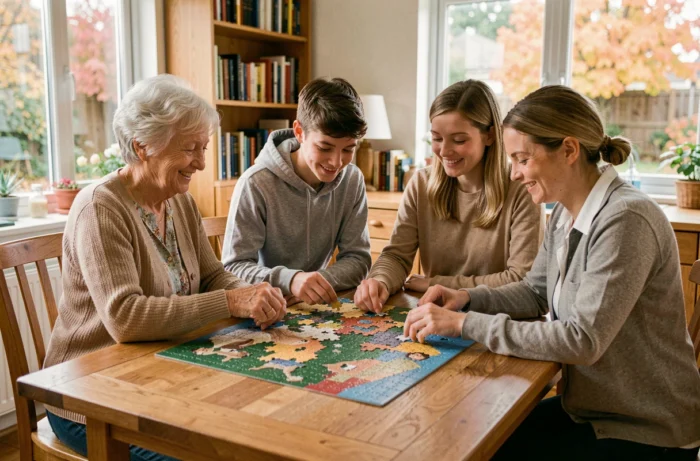
What distinguishes this category in a comparison is the almost infinite reuse for a one-time purchase. A cooperative game bought once can serve for dozens of evenings. In contrast, an escape room costs for each session.
Selection Criteria for a Truly Intergenerational Game
- Game duration: under 30 minutes, young children and seniors stay focused, which broadens the actual audience of the game
- Required reading level: a game based on images or manipulation (dice, illustrated cards) includes non-readers and elderly people with visual difficulties
- Cooperative rather than competitive mechanics: it reduces frustration among younger players and encourages exchange between generations
Creative hobbies (modeling clay, painting, DIY) share this same profile: low entry cost, home practice, adaptable from 3 years. However, their social dimension remains limited to a small group, whereas a board game can bring together six to eight participants.
Libraries in France: The Most Underestimated Free Leisure Activity
Competitors rarely mention media libraries as a leisure activity. Recent data, however, shows a notable phenomenon. According to a Crédoc barometer for the Ministry of Culture, library attendance increased by about 11% between 2023 and 2024. The share of French people who visited a library rose from 32% in 2019 to 37% in 2024.
This increase can be explained by a transformation of the offering. Media libraries now lend video games, musical instruments, and board games. They organize creative workshops, conferences, and outdoor activities (beaches, gardens, nursing homes).
Why This Leisure Ranks High for Families on a Tight Budget
Registration is free or nearly free in most municipal networks. Extended evening and weekend hours, combined with the development of bookmobiles, explicitly aim to reach all audiences and all ages, including those far from cultural facilities.
For a family looking for regular leisure ideas without recurring expenses, the media library offers a range of activities comparable to that of an indoor leisure center, without the entry fee.

Nature Activities and Family Vacations: The Seasonality Factor
Outdoor activities (hiking, biking, swimming in natural bodies of water) dominate the comparison on the cost criterion. They pose a seasonality problem that other categories do not have.
An indoor leisure space or a board game works twelve months a year. Family hiking, however, depends on the weather and geography. This factor partly explains the success of covered structures reported by Ouest-France: parents are looking for reliable alternatives when the weather does not cooperate.
Combining Indoor and Outdoor Activities by Season
- Spring and summer: nature outings, aquatic activities, outdoor treasure hunts. The cost remains minimal if public natural sites are prioritized
- Autumn and winter: board games, home escape games, media libraries, creative workshops. These activities maintain family ties without depending on the weather
- All year round: libraries and board games transcend the seasons. Their versatility makes them the foundation of a family leisure program
The most telling data from the comparison remains that of libraries: a free public service, growing, that covers all ages and all seasons. For families who want to vary their pleasures without multiplying expenses, combining this resource with a few well-chosen board games and occasional nature outings covers the essential desires, from the youngest to the oldest.