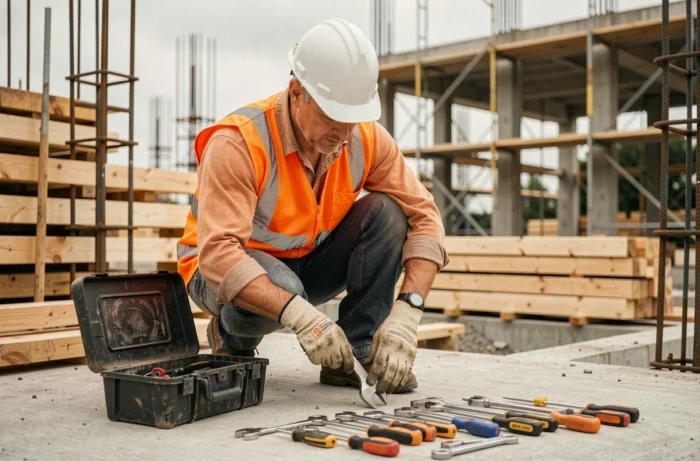
A well-functioning construction site relies on a precisely calibrated equipment fleet, not on an accumulation of tools. Choosing the right construction tools means balancing versatility, regulatory compliance, and holding costs. We review the key areas that truly make a difference on the ground.
Periodic Inspections and Traceability of Construction Equipment
The national labor inspection campaign launched in 2026 specifically targets mobile and lifting work equipment: excavators, mini-excavators, loaders, compactors, forklifts. Inspections, scheduled from September 2026 to January 2027, focus on the operation of machines, mandatory periodic checks, driving authorizations, and the consultation of the CSE on risk assessment.
A compliant machine is no longer enough. Documentary traceability of inspections has become a full-fledged control criterion. Maintenance logs, reports from accredited organizations, driver training certificates: everything must be accessible on-site. Temporary workers and young employees are subject to increased scrutiny, with heightened requirements for supervision and prior training.
In practice, we recommend centralizing these documents in a digital tool rather than in a construction site binder. Several field tracking solutions today allow linking each inspection to the relevant machine and triggering alerts before deadlines.
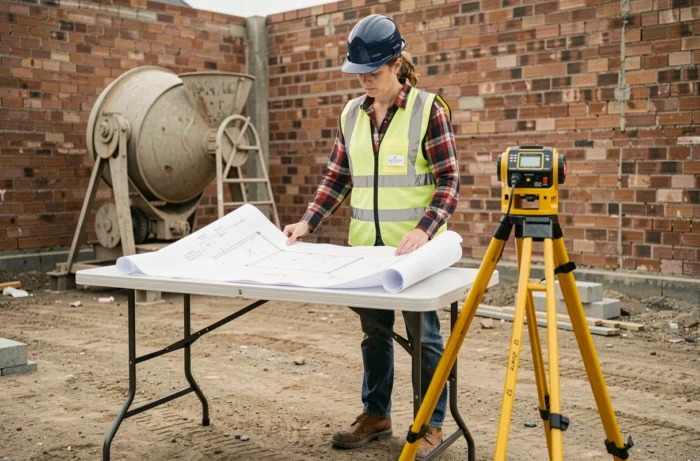
To identify the categories of equipment involved and compare references suitable for your operations, the equipment available on ARTS Constructions covers a wide spectrum, from lifting machines to handling accessories.
Portable Power Tools on Site: Balancing Power and Autonomy
The choice of a hammer drill, grinder, or saw is not just about the technical specifications. On a major construction site, the central question is the relationship between delivered power and actual autonomy under intensive working conditions.
Interchangeable battery platforms have changed the game. The same pack powers a hammer drill, impact driver, grinder, and area lighting. This reduces the number of chargers on-site and simplifies logistics, provided you stick to a single manufacturer’s ecosystem for each batch of equipment.
The SDS-Plus remains the standard for common drilling in concrete and masonry. The SDS-Max takes over beyond a certain drilling diameter or for heavy chiseling. We observe that many sites underestimate the wear on tool holders: a worn tool holder degrades energy transmission and accelerates drill breakage.
Selection Criteria for a Consistent Portable Tool Fleet
- Battery compatibility: ensure that the voltage and pack format cover at least three tools from the current fleet (hammer drill, grinder, lighting)
- IP protection rating: a minimum level of protection against dust and water splashes is necessary for outdoor heavy work
- Availability of wear parts: brushes, seals, bearings. A tool whose parts are no longer distributed within a few years becomes a dead cost
- Ergonomics and weight: during a full day of ceiling drilling, every gram counts to limit musculoskeletal disorders
Separation Devices for Machinery and Pedestrians: An Undersized Area
The coactivity of machinery and pedestrians remains the leading cause of serious accidents on construction sites. Physical barriers, markings, and proximity alert systems are not secondary equipment. They are part of the construction site equipment just like a crane or a compactor.
The 2026 labor inspection campaign emphasizes the organization of traffic routes, signage for pedestrian areas, and effective separation of flows. On medium-sized sites, we find that this area is often addressed with a simple construction tape, where rigid barriers or weighted bollards would be necessary.
Technological solutions are emerging. Some excavators are now equipped with pedestrian proximity detection systems, combining sensors and sound alerts for the operator. This type of equipment does not replace the physical organization of the site, but it adds a layer of active safety in maneuvering areas.
Personal Protective Equipment: Beyond Minimum Regulatory Requirements
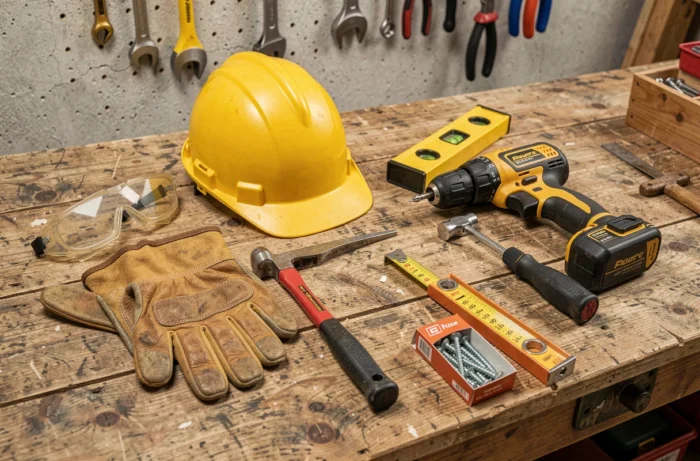
The helmet, safety shoes, and high-visibility vest form the foundation. Everyone knows this. The real question is whether the PPE is suitable for the actual tasks performed, not just their mere presence.
A cut-resistant glove offers no protection against vibrations transmitted by a jackhammer. Each workstation requires specific PPE, not a generic kit. Custom-molded hearing protection, for example, provides superior acoustic attenuation compared to standard foam earplugs while allowing communication on-site.
- Helmets compliant with EN 397: check the expiration date (marked on the shell), often overlooked on long-term sites
- S3 shoes with puncture-resistant soles: S1P level does not protect against water, insufficient for earthworks or outdoor heavy work
- Job-specific gloves: cut-resistant for rebar, anti-vibration for pneumatic tools, insulated for work near electrical installations
Management of the PPE Fleet on Site
Distributing PPE is not enough. Their renewal, storage, and traceability fall under the responsibility of the site manager. A helmet exposed to the sun for several months loses its mechanical properties. Gloves stored in a damp locker deteriorate before even being worn.
We recommend maintaining a simple register, even on a spreadsheet, linking each distributed PPE to an employee, a handover date, and a projected replacement date. This tracking becomes even more relevant with the strengthening of controls on vulnerable groups (temporary workers, apprentices).
Construction equipment is not limited to what digs, cuts, or lifts. Documentary compliance, flow separation, and reasoned choice of individual protections weigh as heavily in the success of a site as the power of an excavator or the precision of a leveling laser. The 2026-2027 control campaigns remind us that equipment also means proof that it is checked, maintained, and used by trained operators.