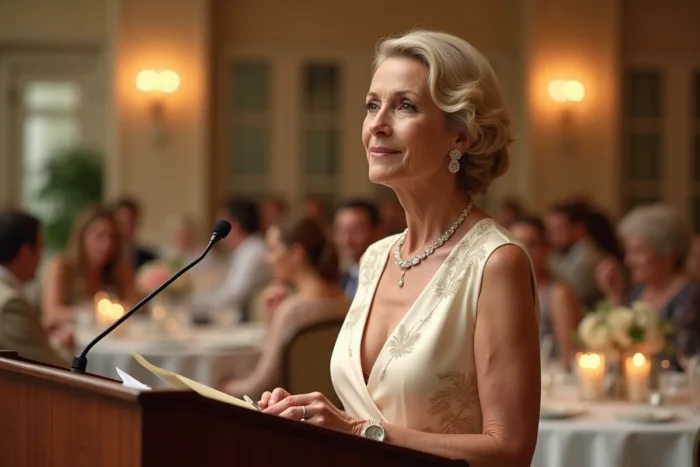
For a mother speaking at her son’s wedding, the question of tone and sincerity weighs much more than the length of the text or the choice of quotes. The adopted tone, structure, and degree of frankness determine the impact of the speech on both the guests and the couple.
Tone of a Mother’s Wedding Speech: A Comparative Approach
The choice of tone determines how the speech is received by the guests and the couple. Three tones are commonly found in most ceremonies, each with distinct effects on the audience.
| Tone | Main Effect | Main Risk | Recommended Duration |
|---|---|---|---|
| Emotional / Intimate | Tears, feeling of family closeness | Discomfort if too personal in front of a large audience | 3 to 4 minutes |
| Humorous | Relaxation, complicity with the guests | Poorly received anecdote by the in-laws | 2 to 3 minutes |
| Mixed (emotion + humor) | Varied rhythm, maintained attention | Clumsy transition between the two tones | 3 to 5 minutes |
The mixed tone is the most effective in most family configurations. It allows for diffusing the tension of a strong memory with a light touch, then returning to emotion without losing the audience’s attention.
Looking for a sample speech from a mother for her son’s wedding helps visualize this alternation between tender memories and lighter moments, especially when starting from a blank page.
Mother of the Groom’s Speech When the Relationship Has Been Conflictual
Not all mother-son relationships follow a linear and warm path. Some mothers have gone through years of distance, disagreement, or silence with their son before reconnecting.
The strongest emotion often arises from a difficult journey handled with delicacy. Publicly acknowledging that there were complicated periods, without going into details or settling scores, creates an effect of sincerity that “perfect” speeches do not achieve.
What Can Be Said Without Making It Uncomfortable
The line between sincerity and discomfort lies in a simple rule: name the trial without detailing it or assigning blame. A phrase like “we haven’t always walked in step, but we eventually found each other” says a lot without exposing anyone.
- Refer to the journey taken rather than the mistakes made, using “we” instead of “you” or “I”
- Position reconciliation or closeness as the endpoint of the speech, not as a confession in the middle of the text
- Address a direct word to the daughter-in-law or son-in-law to anchor the speech in the present and not in the past
This approach works because it respects the intimacy of the relationship while showing the guests that the couple is building on a real foundation, not on a smooth image.
Effective Structure of a Mother’s Speech for Her Son’s Wedding
Many mothers scatter their thoughts due to a lack of structure. A successful wedding speech relies on three blocks, no more.
Block 1: Anchoring in a Specific Memory
Open with a concrete anecdote. Not a generic memory (“you were a wonderful child”), but a specific moment with a place, an age, a visual detail. This type of opening captures attention because it projects the audience into a scene.
A funny memory works better as an opener than an emotional one. Emotion gains power when it follows a moment of lightness.
Block 2: Transition to the Adult He Has Become
This passage connects the child to the groom. It is the moment to name a quality that the mother has seen develop over time. However, abstract phrases (“you have become a wonderful man”) fall flat if not tied to a fact.
Tying each quality to an observable moment makes the speech credible. “I realized you had grown the day you made that decision” is better than a list of adjectives.
Block 3: Addressing the Couple
The speech ends by addressing the couple rather than just the son. Welcoming the daughter-in-law or son-in-law by name is a simple gesture that changes the impact of the speech. It transforms a maternal declaration into a family blessing.
Common Mistakes in a Mother’s Wedding Speech
Some awkwardness recurs from one wedding to another. Identifying them allows for avoidance without excessive self-censorship.
- Talking more about oneself than about one’s son: the speech becomes a monologue about motherhood instead of celebrating the couple
- Reading a text that is too long: beyond five minutes, guests’ attention sharply declines, even with a good text
- Multiplying quotes or poems found online: one well-placed quote is enough, the rest should come from oneself
- Addressing exclusively one’s son while ignoring the person he is marrying, which creates visible discomfort in the audience
The trend observed among officiants of secular ceremonies in 2025 and 2026 confirms that the most memorable speeches are those where the mother does not seek rhetorical perfection but authentic presence. A text read with trembling in the voice touches more than a flawlessly recited speech.
A mother’s speech for her son’s wedding does not need to be long or literary. A true memory, a quality illustrated by a fact, a sincere word addressed to the couple: these three elements are enough to create a strong moment, regardless of the family history.