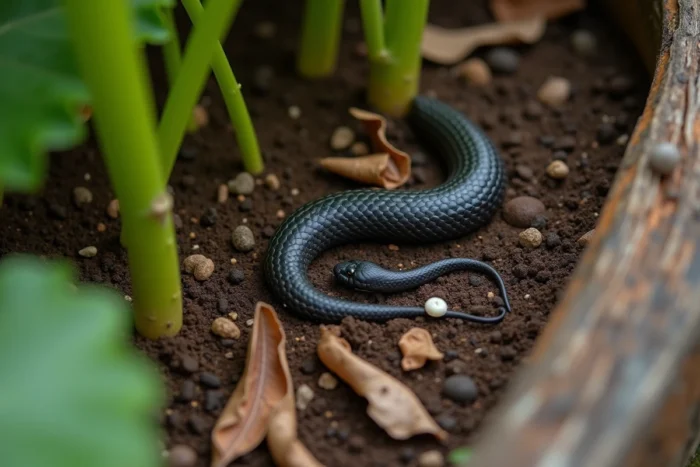
While weeding a flowerbed or turning over a planting bed, you may sometimes come across a small dark pile topped with a white spot. The usual reflex is to push it aside with the tip of the spade without thinking. However, this snake droppings provide concrete information about the state of the garden and the wildlife that circulates there.
Double fecal component: the criterion that distinguishes snake droppings
The most common confusion is between snake droppings and those of rodents (field mice, voles) or birds. One criterion settles the debate: a dark fecal part fused with a white mass of urates. These urates are solidified urinary waste that snakes expel at the same time as their feces, which does not occur in garden mammals.
Specifically, one observes a dark brown, sometimes almost black, sausage shape, extended or topped with a white to pale yellow deposit. The size varies according to the species and age of the snake, but this two-part structure remains constant. In comparison, rodent droppings appear as small uniform pellets, without any white trace.
You can also tell if the reptile is doing well by looking at the color of the urates. When trying to recognize snake droppings in the garden, the shade of the urates serves as a reliable indicator: white to very pale yellow urates signal a healthy animal. Clearly yellow or orange urates reveal dehydration or renal stress in the snake.
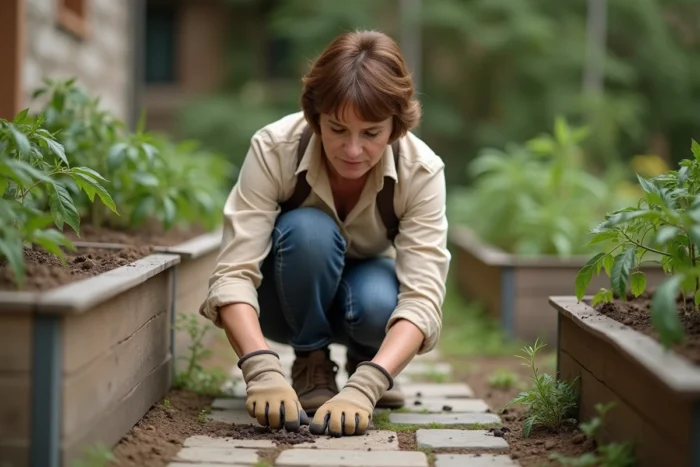
Orange urates in the garden: adapting the terrain to the received signal
Finding colored urates during a heatwave is not anecdotal. The snake frequenting the garden is likely suffering from a lack of water or cool areas. We can act on this without excessive effort.
- Maintain a water point on the ground, even modest (buried saucer, dish near the compost), so that the reptile can hydrate between hunts.
- Keep areas of moist cover: thick mulch, piles of flat stones in the shade, tiles stacked against a wall. These shelters limit evaporation and provide a cool microclimate.
- Avoid mowing the entire garden at once. Leaving a strip of tall vegetation along a hedge or wall allows snakes to move about in cover.
Adapting the terrain to what the droppings indicate transforms a simple waste into a management tool. The garden becomes more hospitable for the reptile, and the reptile better regulates the rodents.
Snake droppings and pest regulation: what its presence signals
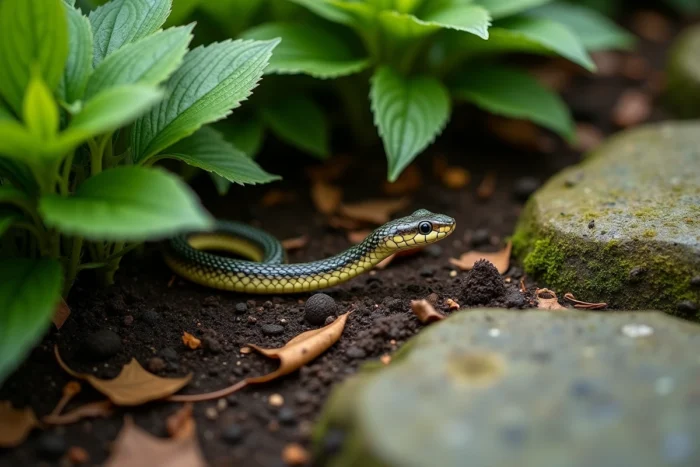
A grass snake, the most common species in French gardens, primarily feeds on voles, slugs, and small amphibians. Its regular presence in a green space indicates a functional ecosystem, with enough prey to support a predator.
Finding several droppings over a season, in different areas of the land, confirms that the snake is not just passing through. It has incorporated your garden into its hunting territory. For a vegetable garden, this means natural pressure on the voles that nibble on the roots and on the slugs that ravage the seedlings.
What the droppings sometimes contain
Upon close inspection (with a stick, not fingers), one may sometimes spot undigested remains in the dark part: rodent hairs, tiny bone fragments, insect shell residues. These elements confirm the snake’s diet and allow you to know which prey it consumes on your land.
If the droppings mainly contain hairs, the snake is hunting micromammals. This is the most favorable scenario for a gardener facing rodent damage to their crops.
Frequent confusions: snake, hedgehog, or lizard droppings
On the ground, identification errors are common. Here are the practical distinctions that avoid false diagnoses.
- The hedgehog droppings are cylindrical, black, and shiny, often sprinkled with fragments of insect shells. They never contain a white mass of urates, which immediately distinguishes them from those of a snake.
- Lizard droppings resemble those of snakes (dark part plus white urates), but are much smaller. On a wall or terrace, the size is enough to tell: a few millimeters for a lizard, significantly more for an adult snake.
- Bird droppings also combine a dark part and a white part, but their texture is liquid or pasty, never molded into a compact sausage. They are found on vertical supports (posts, branches), rarely on the ground in covered areas.
Doubt sometimes persists about small droppings found under a board or tarp. In this case, the sausage shape with attached urates remains the decisive criterion. Opinions vary on this point when the droppings are old and dried out, as the urates lose their whiteness over time.
Protecting the snake in the garden: regulatory reminder
All snakes present in metropolitan France are protected species. Killing, capturing, or destroying their habitats is subject to penalties. The grass snake, in particular, is perfectly harmless and does not bite, even when touched accidentally while gardening.
The best reflex when encountering snake droppings is to leave them in place or move them to the compost. They decompose quickly and add a bit of nitrogen to the pile. Welcoming a snake rather than chasing it away remains the most beneficial gesture for a garden looking to limit chemical treatments against rodents or slugs.
Ultimately, the next droppings you find at the foot of the wall deserve a careful look rather than a spade’s strike. Its color, composition, and location tell a precise story about the balance of your land.