
On a Peugeot 307 HDi, a check engine light that stays on after an intervention, electric windows that no longer respond, or a temperamental immobilizer often point to the same culprit: the BSI. This intelligent service box centralizes the electronic management of the cabin, and a simple poorly executed battery disconnection is enough to destabilize it. Resetting the BSI allows you to reset its temporary parameters, but the process requires a precise protocol to avoid worsening the situation.
Concrete symptoms that justify a BSI reset on Peugeot 307 HDi
Before disconnecting anything, check that the problem indeed comes from the BSI and not from a blown fuse or a faulty sensor. Several real-world situations indicate a reset.
- The electric windows go up or down partially, without reaching the stops, and the learning of the travel no longer occurs automatically.
- The dashboard displays inconsistent warning lights (airbag, power steering, immobilizer) while no mechanical failure is detected.
- The engine refuses to start after a battery replacement or a deep discharge, with the key transponder no longer recognized by the system.
- The cabin peripherals (interior lighting, wipers, central locking) operate erratically or do not respond at all.
If several of these symptoms are found simultaneously, resetting the BSI is the first avenue to explore. You can rely on this guide for resetting the BSI on Peugeot 307 to complete the diagnosis before proceeding with the manipulation.
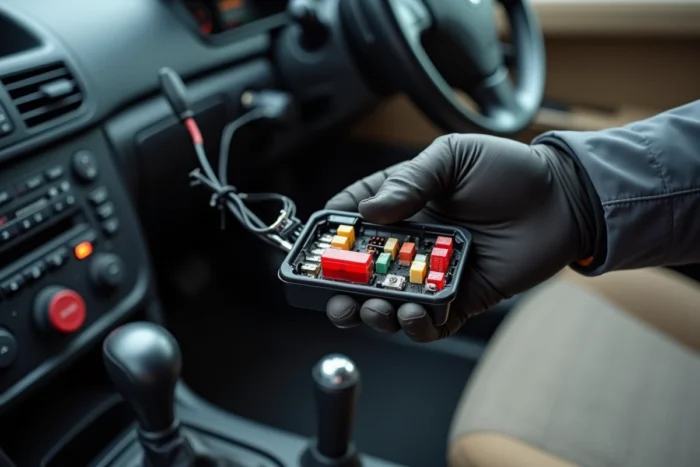
BSI reset protocol via the battery: every minute counts
The PSA procedure relies on a sequence of battery disconnection and reconnection with strict latency times. Skipping a step or shortening a delay can render the reset ineffective, or even cause a desynchronization between the BSI and other controllers.
Preparation before disconnection
Start by turning everything off: lights, car radio, ventilation, GPS. Then open the driver’s door and turn off the ignition.
Waiting for the click of the BSI relay before touching the battery is the most often neglected condition. This click, audible near the cabin fuse box, indicates that the BSI has completed its standby mode. The delay varies by vehicle, but waiting about three minutes after turning off the ignition provides a sufficient margin.
Disconnection and latency time
Once the relay has reset, disconnect the negative terminal of the battery. Leave the circuit open for five minutes. This time allows the capacitors of the BSI and other electronic controllers to discharge completely. Shortening this delay is the primary cause of reset failure.
Then reconnect the negative terminal without turning on the ignition and without touching any electrical controls. Two minutes of waiting after reconnection, with the ignition off, allows the BSI to reset and restart its self-diagnostic routines.
Restart and verification
After the two minutes, turn on the ignition (accessory position), then start the engine. Check the dashboard: the warning lights should briefly illuminate when the ignition is on and then turn off. If a warning light persists, the problem likely exceeds a simple software reset.
The electric windows often lose their travel learning after a reset. To recalibrate it, raise each window to the upper stop and hold the button down for two seconds. This manipulation reprograms the end-of-travel position in the BSI’s memory.
Concrete risks of a poorly executed BSI reset on the 307 HDi
Field feedback from automotive electronics specialists converges on one point: a repeated or sloppy BSI reset can lead to a desynchronization of the immobilizer. The BSI, engine control unit, and key transponder form a synchronized trio. If the battery reconnection procedure does not respect the latency times, these controllers may lose their mutual pairing.
The result: the car no longer starts at all, and only a complete reprogramming of the starting kit (BSI, engine control unit, key) via a manufacturer diagnostic tool like Diagbox can restore communication. Feedback varies on this point depending on the initial state of the BSI, but the risk is real for Peugeot 307 HDi whose box already shows weaknesses.
Another common trap: specialists report an increase in cases of BSI diagnosed as faulty when it is not, after poorly executed battery interventions. Inconsistent warning lights, dead cabin peripherals, no starting: the symptoms resemble a burnt-out box, but a correct reprogramming is often enough to restore it to service.
When the BSI reset is not enough: electronic diagnosis and reprogramming
If the symptoms persist after a clean reset, the problem lies upstream. Three scenarios regularly arise.
The first: a partial corruption of the BSI’s EEPROM memory. The stored data (vehicle configuration, immobilizer code, CAN network parameters) is altered. A simple battery disconnection does not rewrite this data. It is necessary to read and rewrite the EEPROM with a suitable diagnostic tool.
The second: a communication fault on the CAN network. The BSI communicates with the engine control unit, ABS, airbag, and other modules via this network. A damaged cable, a faulty termination resistor, or a secondary controller in short circuit can generate errors that the reset temporarily masks without resolving them.
The third: a genuinely faulty BSI. Burnt power components, cracked solder joints from thermal cycles, corrosion of the connector. In this case, the box must be replaced or repaired, then reprogrammed with the vehicle’s data (VIN, manufacturer code, key pairing).
An electronic diagnosis before any reset attempt remains the most reliable approach to avoid wasting time and risking desynchronization. Reading stored faults, checking CAN frames, and verifying the BSI’s power supplies allow for identifying the real cause before taking action.
The BSI reset via the battery resolves some common electronic malfunctions on the Peugeot 307 HDi, provided that each step of the PSA protocol is followed to the letter. For deeper failures, the manipulation reaches its limits, and using a manufacturer diagnostic tool becomes the only reliable option.