When you open your wardrobe at the beginning of the season, the question is not about replacing everything. It’s about knowing which pieces are worth an investment and which will go through the months without ending up forgotten on a hanger. This year’s fashion trends are reflected as much in cuts and materials as in a regulatory context that is changing the game for brands and, by extension, for us.
Textile Regulation and Limited Collections: What Changes in Store
Since July 19, 2026, large companies in the European Union can no longer destroy their unsold clothing, accessories, and shoes, under the European regulation on the eco-design of sustainable products (ESPR). In France, law no. 2026-602, enacted on July 8, 2026, adds another layer: brands characterized by very rapid turnover of their offerings see their environmental contribution adjusted upwards.
In practice, we are already seeing effects on the shelves. Collections are becoming more streamlined, with fewer references per season. Pre-ordering and organized clearance sales are gaining ground. For us, buyers, this means that a piece spotted at the beginning of the season is less likely to be found on sale a month later, as stocks are calibrated more tightly.
This framework also pushes second-hand items to the forefront. Noble materials bought second-hand, a raw denim sold after two seasons: we are increasingly compiling looks on Myblog’s fashion site that integrate these circuits without sacrificing style.
Fall-Winter Materials: Betting on Thick Wool and Soft Leather

The choice of material determines the lifespan of a garment much more than its cut. This season, heavy and textured materials dominate the fall-winter offerings. We find boiled wool on mid-length coats, corduroy on pleated trousers, and soft leather (or its plant-based alternatives) on short jackets.
Choosing a dense weight ensures durability over time, especially for pieces worn daily. A wool blend pant with 60 or 70% wool resists pilling better than a lightweight synthetic fabric. Feedback varies on this point depending on the brands, but the general rule holds.
Materials to Watch Closely
- Brushed mohair, found on oversized sweaters and wide scarves, adds volume without excessive weight.
- Thick raw denim, crafted into straight jeans or workwear jackets, is back with more refined finishes than a few seasons ago.
- Matte satin, used on midi dresses and skirts, creates an interesting contrast with the rough textures of the rest of the wardrobe.
Trendy Women’s Silhouettes: Controlled Volume Rather Than Total Oversize
Oversize has long meant “two sizes up.” This year, the silhouette becomes clearer: we keep the volume on one piece and structure the rest. Wide trousers are worn with a fitted top. A loose coat pairs with straight jeans, not shapeless joggers.
For dresses, the midi length remains dominant. Shirt cuts in thick cotton or poplin are worn belted. It’s a chic yet relaxed style that works just as well in the office as it does outdoors on the weekend.
The Return of the Relaxed Suit
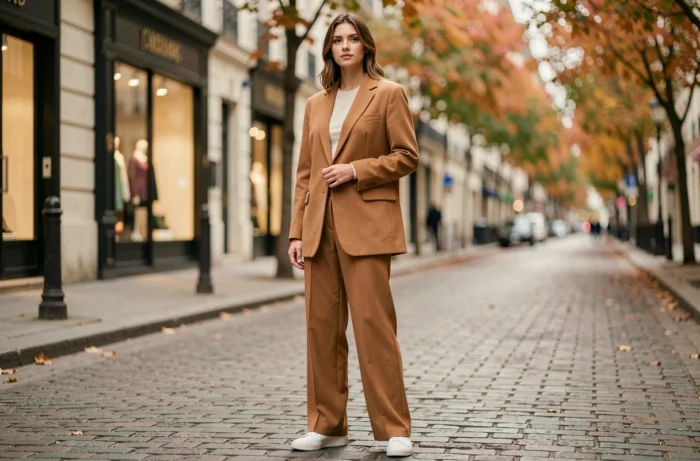
The slightly deconstructed blazer, paired with matching trousers but in a different material (linen versus wool, cotton versus velvet), forms an ensemble that replaces the classic suit. Mixing materials in the same outfit adds character effortlessly.
This type of look easily absorbs a subtle print, a houndstooth pattern, or fine stripes, without falling into excess. Animal prints, which were very present last season, are giving way to more subdued geometric patterns.
Seasonal Colors and Prints: Beyond Systematic Black
Black remains a staple, but this season, two families of shades are gaining visibility:
- Warm earthy tones (chocolate, caramel, terracotta) work well on outerwear and leather accessories.
- Cool muted tones (slate gray, petrol blue, deep burgundy) dominate knits and dress trousers.
- Off-white, worn in a total look or in contrast with a dark piece, creates a luminous effect even in the dead of winter.
Pairing two neutral tones from different families (a caramel with a slate gray, for example) produces a more contemporary result than an all-black monochrome. We avoid monotony without resorting to bright colors that are difficult to match from season to season.
Building Sustainable Looks Rather Than Accumulating Pieces
With shorter collections in stores and prices reflecting environmental contributions, the purchasing logic is evolving. It’s better to have three well-chosen pieces than a dozen disposable basics. A good pair of raw jeans, a wool blazer, and a pair of soft leather ankle boots cover most autumn-winter situations.
The most concrete advice remains to try before buying, including online with clear return policies. The fit matters more than the current trend. A perfectly fitted midi dress at the shoulders and waist can last through several seasons. A trendy print but poorly cut ends up at the back of the closet by February.
This year’s fashion trends reward thoughtful purchases. The European regulatory framework pushes in this direction, brands are adjusting their volumes, and the materials offered are improving in quality in the mid-range segment. It’s worth taking advantage of this to invest in pieces that will last beyond a single season.