
Arkevia stores pay slips, employment contracts, and certificates in an encrypted space accessible from any connected device. The platform guarantees the availability of these documents for several decades, even after leaving the company. However, with the regulatory changes of 2026 and the strengthening of authentication mechanisms, the concrete functioning of the Arkevia digital safe deserves a precise examination.
CNIL Reference 2026 and retention periods: what changes for Arkevia
Competing guides remind us that access to the safe remains active after the end of an employment contract. They overlook a structuring point: the CNIL reference published in 2026 specifies the obligations related to an employee’s departure.
Three distinct retention periods now coexist in the ecosystem of dematerialized payroll:
- Identification elements related to payroll must be kept for 6 years after the last DSN submitted.
- The employer’s copy of the pay slip remains archived for 5 years.
- The availability of the electronic pay slip for the employee must be guaranteed for 50 years or until retirement age plus 6 years.
This framework requires Arkevia to manage a technical switch at the time of departure: deactivation of the employer’s account, transition to intermediate archiving, and maintenance of the employee’s residual access rights. In practice, the employee retains full personal access to their documents, while the former employer loses all visibility into the contents of the safe.
A comprehensive guide on Arkevia safe details the steps of this transition and the rights associated with each user profile.

Strengthened authentication on Arkevia in 2026: moving to two-factor verification
Until recently, access to the safe relied on a classic username-password pair, sometimes supplemented by a secret code provided by the employer. In 2026, Arkevia will generalize two-factor authentication (2FA) across all accounts.
This change modifies the daily login procedure. After entering the password, a temporary code is sent via SMS or through an authentication app. The login only succeeds after validating this second factor.
Concrete impact on the first login
During the initial activation, the employee must now associate a personal phone number or configure a dedicated app. This step is in addition to creating the password and providing a personal email address (distinct from the work email).
For employees leaving their company, the 2FA remains linked to the personal number, not the work number. A change of phone number without prior update in Arkevia can block access to the safe. The recovery procedure then goes through technical support, with identity verification.
Arkevia digital safe and tax obligations: the reform of September 2026
Article L.102 B of the Tax Procedure Code imposes, starting from September 1, 2026, extended retention periods for certain accounting and tax documents. This reform does not directly target employees’ pay slips, but it pushes archiving service providers to harmonize their practices.
Arkevia, as a digital safe operator, must ensure that archived documents remain intact and accessible over periods that exceed the strict HR framework. Companies using the platform to store documents beyond pay slips (tax certificates, work certificates) are directly affected.
| Obligation | Retention Period | Legal Basis |
|---|---|---|
| Pay slip (employee) | 50 years or retirement + 6 years | Labor Code |
| Employer’s copy | 5 years | Labor Code |
| Payroll identification / DSN | 6 years after last DSN | CNIL Reference 2026 |
| Tax documents (company) | Extended periods starting Sept. 2026 | Art. L.102 B LPF |
This table shows that four different retention regimes can coexist in the same Arkevia safe. The fine management of deletion dates or transitions to permanent archiving becomes a technical challenge for the platform.
Legal value of documents and NF Z42-020 standard
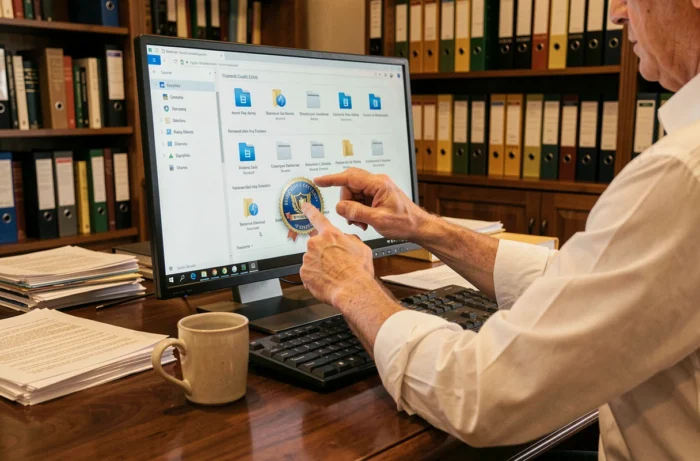
A digital document only has probative value if it meets strict conditions of integrity, timestamping, and traceability. Arkevia relies on the NF Z42-020 standard, which governs the technical components of a digital safe: data encryption, sealing at entry, access logging.
Digital sealing freezes the document at the time of its deposit. Any subsequent modification is detectable, ensuring that the pay slip viewed five, ten, or thirty years later is rigorously identical to the one issued by the employer.
Hosting and GDPR compliance
Data is hosted in France, a necessary condition for GDPR compliance. AES-256 encryption protects files at rest and in transit. Only the safe holder can view or download their documents – the employer loses this access after the employee’s departure, in accordance with the CNIL reference.
The combination of the NF Z42-020 standard and the GDPR framework makes Arkevia a certified legal archiving tool. A pay slip extracted from the safe can be produced as evidence in court or before a retirement organization without any possible dispute regarding its authenticity.
The simultaneous strengthening of authentication, the entry into force of new tax durations, and the update of the CNIL reference in 2026 place Arkevia in the face of increasing regulatory complexity. For the employee, the key takeaway remains simple: associating a personal email address and phone number with the safe guarantees enduring access, regardless of any change of employer.